
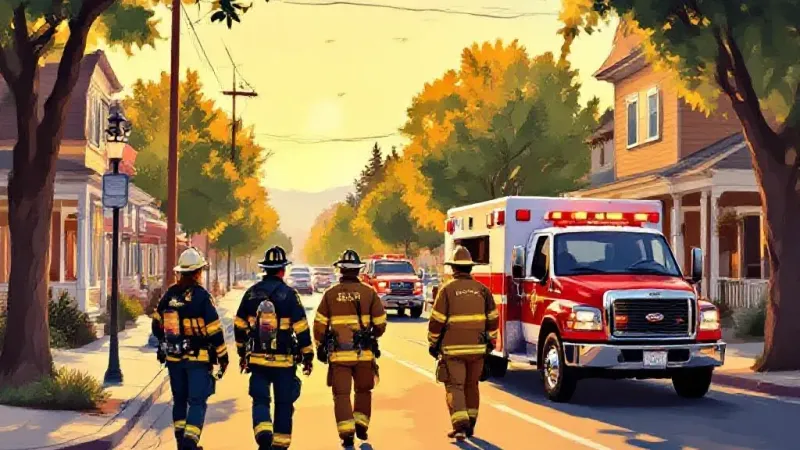
Emergency responders from the Meridian, Linda, Yuba City, and Sutter fire departments, alongside Bi-County Ambulance employees and emergency medical technicians, participated in a Mass Casualty Incident (MCI) training on Wednesday at the Bi-County Ambulance building on Poole Street in Yuba City. The annual training, organized by Bi-County Ambulance's education and training specialist Dara Dunn, aims to prepare first responders for potential emergencies, particularly in anticipation of the upcoming Sikh Parade. This year's parade, scheduled for November 1, is expected to draw approximately 150,000 attendees to Yuba City, a city with a total population of 70,000.
Dara Dunn, an emergency medical technician, has organized this preparedness training for more than 20 years, striving to simulate a real disaster event as closely as possible. Dunn noted that a significant push for this training occurs every October in preparation for the Sikh Parade, which she identified as having a potential for a mass casualty incident. About 15 regional first responders engaged in the exercise, which addressed the complexities of managing a crowd of injured individuals. Yuba City Fire Department Captain Justin Johnson, for instance, inquired whether a scenario might involve a "trampling incident, or a drug incident," to which Dunn clarified it could encompass both trauma and drugs.
The training began with an indoor discussion of procedures, including locating victims, triaging them, and using a color-coded tagging system. This system involves placing specific tags around a patient's neck and a matching one in their pocket for the medical communications coordinator, Bi-County paramedic Jerry Hofmann. Tags are color-coded to describe conditions: green for minor, red for immediate, black for deceased, and yellow for delayed. Participants also viewed a film from Ventura County depicting a mass casualty event to set the context for their duties. Dunn stated that the ultimate goal of MCI response is to relocate victims from the scene and to their appropriate destinations in a perfectly orchestrated manner.
Alerts are sent to area hospitals, known as control facilities, in an MCI event, providing emergency personnel with information on available beds within five to ten minutes. A surge alert is established for incidents involving three or more ground or air units. Dunn highlighted that the local area is unique because Adventist Health & Rideout is the only hospital with certain capabilities within a 45-mile radius. Incidents are categorized into three levels: level one for up to 14 patients, level two for 15 to 49 patients, and level three for 50-plus patients. Dunn observed that triaging, sorting, and transporting 50 or more patients would be "a lot of work," and a suggestion to use buses for transport was dismissed due to hospitals' likely inability to accept such a large number of people at once.
Discussions also covered logistics for air ambulances during the parade, with Yuba City Fire Battalion Chief Eric Hankin noting that landing an aircraft directly in the "travel route" would not be feasible. Participants ultimately decided that an ambulance would transport patients to an aircraft. Dunn guided responders through various scenarios, describing patients with injuries ranging from bleeding to incoherence, as well as specific considerations for babies, children, or pregnant women. The challenge, Dunn instructed, is to identify which patient has the most severe injury.
For the practical exercise, 16 cardboard "patients," each labeled with vitals, were hidden both outside and inside a warehouse. Strobe lights and loud music were used to simulate the chaotic environment of an actual MCI event. Responders located these simulated patients, marked them with the appropriate color-coded tags, and placed them on matching colored tarps. Dunn noted that conditions can deteriorate rapidly in such events, recounting one simulated patient whose condition progressed from delayed to deceased—a somber reality that can occur in large-scale incidents, she reflected. While some tags were initially missing and required re-triaging, the teams worked together to match all tags. Dunn acknowledged that the training exercise concluded quicker than an actual catastrophe, where communication might be more challenging, potentially requiring runners to relay information.
Meridian Fire Chief Robert Stoddard, who also serves as a Fire Technology coordinator at Yuba College, emphasized the importance of this training, particularly for those new to the field. Stoddard explained that reviewing procedures helps create ingrained responses, and he stressed that "Joint training like this is critical." The coordinated effort among regional agencies, including local fire departments and Bi-County Ambulance, ensures continued preparedness for large-scale community events like the upcoming Sikh Parade in Yuba City.